Ian Jones
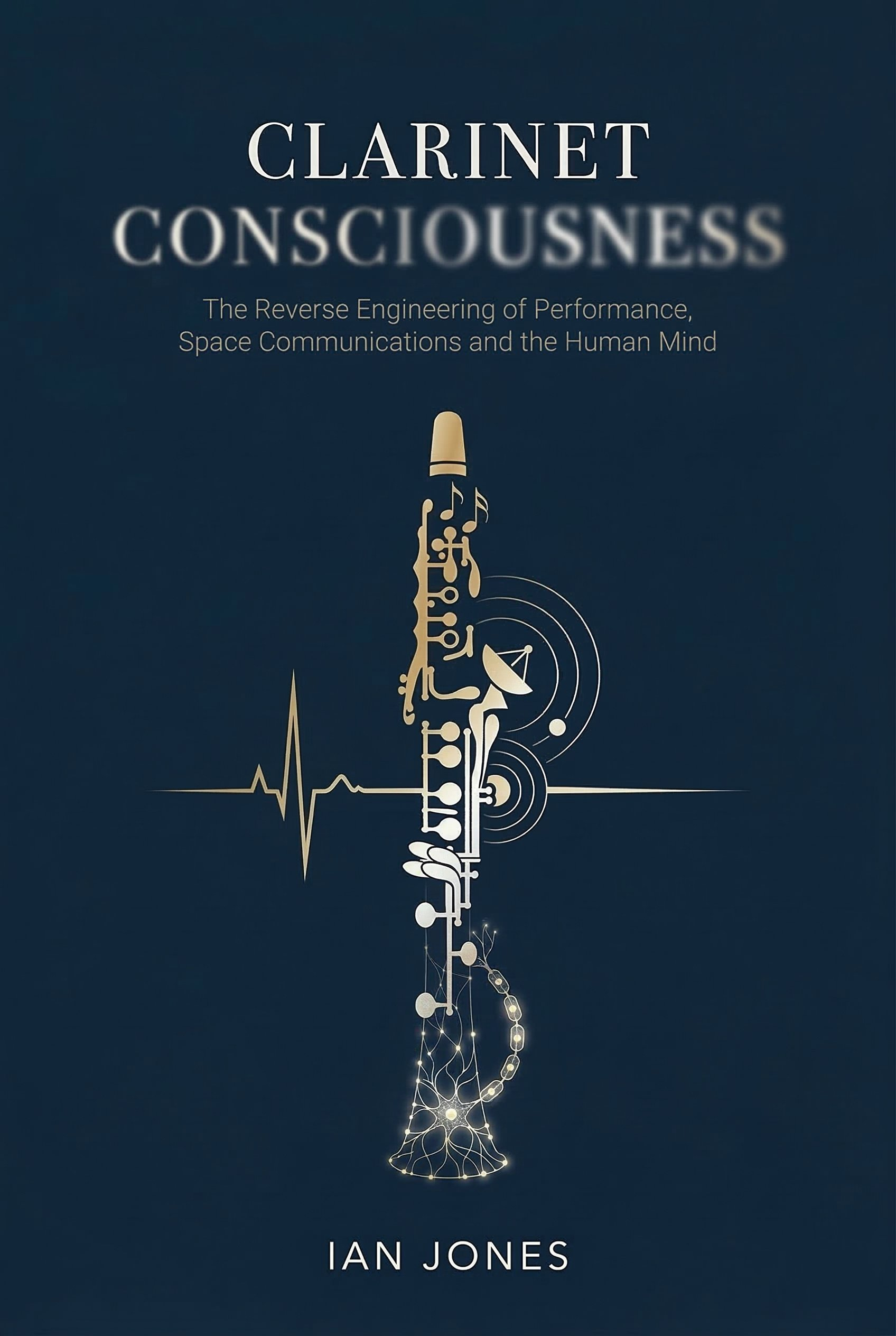
Clarinet
Consciousness
What happens in your brain when you listen to music?
The Reverse Engineering of Performance,
Space Communications and the Human Mind
“A satellite engineer who founded Britain's deep space communications station picks up his clarinet to play the opening solo of Sibelius's First Symphony — discovers he has no mind's eye — and in the act of playing uncovers a new theory of consciousness, hidden in plain sight in the mathematics of signal processing and in Sibelius's music itself.”
Everything in this book comes down to timing.
The Book
Clarinet Consciousness is a work of non-fiction structured as four symphonic movements. It follows one man's journey from a child of the Apollo era — learning about music, electronics, and medical life-support control rooms — through a career designing state-of-the-art digital satellite communication equipment and the entrepreneurial gamble of creating the world's first commercial deep space communications station, to the ultimate realisation that consciousness is a function of the timing circuits of the brain and body. The story plays out as the symphony is performed, revealing remarkable parallels between the arc of the narrative, the symphony itself, signal processing, the act of playing music, and the processes of the mind. The author's discovery of his own aphantasia — the lack of a mind's eye — provides the structure that reveals the links between these seemingly unrelated threads. In much the same way that Sibelius composes a masterful symphony from fractal parts, and Douglas Adams hides a theory of philosophy in plain sight within the absurdity of his narrative.
Ian Jones founded Goonhilly Earth Station on the Lizard Peninsula, transforming a decommissioned BT satellite facility into the world's first commercial deep space communications ground station. He is a digital signal processing engineer, an amateur clarinettist who performs at orchestral level, and the owner of a mind that cannot produce a single mental image. It is the collision of these three lives — engineering, music, and a profoundly different kind of cognition — that makes this book possible. No one else stands at this particular intersection.
For readers of Daniel Levitin's This Is Your Brain on Music, Douglas Hofstadter's Gödel, Escher, Bach, Daniel Kahneman's Thinking, Fast and Slow, and John Powell's How Music Works — yet no existing title combines all four of this book's domains. Written for a general audience, it will be loved by the world's fifteen million clarinettists and the wider community of orchestral musicians, by devotees of Sibelius, by anyone who has ever wondered how their mind works, by the neurodivergent who suspect their difference is an advantage, by engineers who know that the best explanations are elegant, and by Douglas Adams fans who always suspected the answer wasn't forty-two. The manuscript, at 56,000 words, is complete. A full proposal and sample chapters are available on request.
Everything that follows comes down to timing. The brain operates across multiple timescales — from milliseconds to hours — and each layer plays a different role.

A Book in Four Movements
Andante, ma non troppo
From the Apollo era: building radios, learning to play music, learning the control theory of survival.
Andante (ma non troppo lento)
The toolkit. Orchestral playing, designing satellite modems, discovering aphantasia — and the framework that will later explain everything.
Scherzo
Skills mastery. How we do it, what we can achieve, and the Goonhilly story.
Quasi una Fantasia
The argument. Consciousness as timing. The theory hidden in plain sight.
Andante, ma non troppo
From the Apollo era: building radios, learning to play music, learning the control theory of survival.
Andante (ma non troppo lento)
The toolkit. Orchestral playing, designing satellite modems, discovering aphantasia — and the framework that will later explain everything.
Scherzo
Skills mastery. How we do it, what we can achieve, and the Goonhilly story.
Quasi una Fantasia
The argument. Consciousness as timing. The theory hidden in plain sight.
About the Author
An engineer who built Britain's gateway to deep space.
A clarinettist who performs Sibelius.
A mind that cannot form a single mental image.
This book could only come from here.
For Agents &
Publishers
A complete manuscript is available, along with a full proposal, sample chapters, and market analysis. Please get in touch to request materials.
Request the Proposal